A study of Jacques Hétu’s compositional style, including his use of Messiaen’s Modes of Limited Transposition. Published in Perspectives of New Music, vol. 51, no. 1, 2013 (accessible through JSTOR; see your local library).
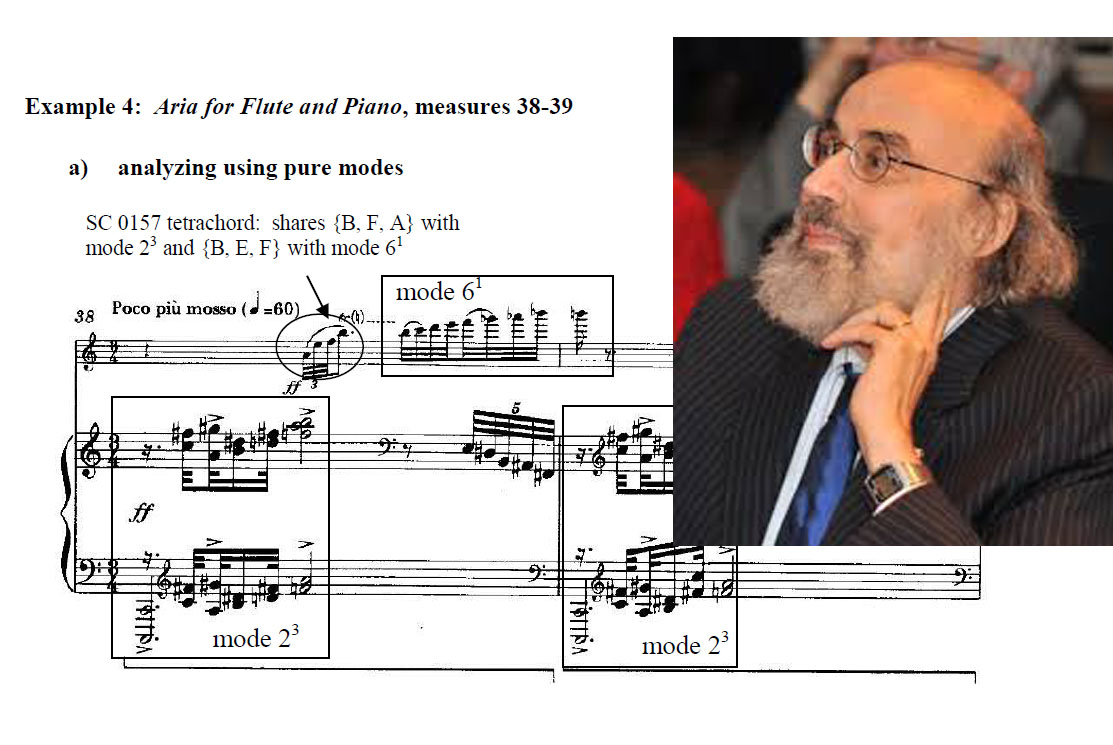
Jacques Hétu (b.1938), a French-Canadian composer based in Montréal, is known for a style that blends octatonicism, chromaticism, a focus on repeated melodic units, and neolassical formal structures. His pitch structures frequently employ the modes of limited transposition and a superimposition of independent melodic layers, suggesting the influence of his teachers Clermont Pépin, a former student of Messiaen, and Messiaen himself. Because Hétu adapts Messiaen-inspired elements in relatively consistent ways, an analysis of his works lends itself well to the use of transformational theory. Two methods are detailed by which Hétu associates superimposed layers: by adding an additional pitch class to a symmetrical collection in order to create musical layers with common subsets, and by combining layers that incorporate similar subsets or transformational motives. Both methods can be expressed through transformations and network isography. By comparing the resulting analyses to previous analyses of Bartók, Stravinsky, and Messiaen, these transformational techniques outline the defining features of Hétu’s compositional style. Excerpts from several of Hétu’s works are analyzed including the variations for piano, op. 8 (1964); Prélude et danse, op. 24 (1977); Aria, op. 27 (1977); string quartet no. 2, op. 50 (1991); and the sonata, op. 35 (1984).
 Stephanie Lind
Leave a comment